
The Long and Bumpy Road

Howling dogs, cockerels and large magpie type birds on the balcony did not make for a good night's sleep, however a delicious breakfast of avocados, eggs and potatoes soon woke us up. We passed on honey in our coffee after the bishop spooned out the ants, some were still enjoying their feast.

At 10am we were to meet with a lady’s group at the church, these ladies are just like us, they meet for prayer, bible study, discussion and to share their challenges, which may not all be quite the same as ours, but many are. We read from Proverbs 31 v 10 - 30 and it was interesting to see how literally they took the passage, “this is written for women with large capital” and “but I cannot sew” were just two of the comments, they did not see it as a picture of being the best they could be in their own situations. Sadly, we felt that for some it made them feel that the Bible was not relevant to them. Not everything was translated and we left before the meeting ended, but we pray they received some guidance in understanding this passage better.
We distributed tennis balls for their children, much to their delight, and took our leave, a school visit awaited.

Gatoki School is a Government Aided School, owned by the church but with funding from the government for teachers etc. It is accessed via a VERY rough road on a ridge between two valleys, did we mention Bishop Jean Pierre is a reluctant driver? As the car rocked, slithered and shook its way to the top, grounding on more than one occasion, we admired the views, particularly across Lake Kivu. Some children were leaving school and met us on the way down, the shouts of muzungu certainly arrived before we did.
Gatoki School takes children from Nursery 1 to Primary 6, they have three nursery levels with 94 children and three teachers all sharing one classroom. They told us this is currently their biggest challenge as they need more classroom space, the land is available but as always, the funding is not.
The government stipulates that the children must only be asked for 1000rwf (50p) per term for lunch (which is compulsory) but of course it costs far more than that to feed them, this is an extra burden on the school budget. We visited the vegetable garden which had been supported with seeds to help supplement the lunches, they had planted a perennial crop which should grow repeatedly and will help provide the food needed. It was not terribly impressive as we are between seasons but it was good to see its potential.
Many of the children were in ragged uniforms that were often too small for them, and we learnt that many struggle to afford the school requirements. This did not stop them being smiley and excited to see, and touch, the muzungu, except the ones who were not quite brave enough!!
Getting to and from the car through the throng of children is a challenge, we say hello/goodbye and hold as many hands as possible, always aware that missing anyone could be a huge disappointment for that child. A car, let alone one carrying a bishop and two muzungu, is a rare sight in this community, but eventually we have to leave, waving and calling goodbye as dozens of little children run alongside, precariously close to the wheels, always a heart stopping experience.

As we headed down the track 3 men were busy filling the worst area with stones and soil, they had obviously seen us struggling up the hill, how very kind. We reached the bottom safely and headed back to the restaurant we failed to eat at yesterday, the bishop had phoned ahead and placed the order and very soon after arriving our meal arrived, and very good it was too, there is something to be said for planning ahead.
We returned to the guest house with the bishop’s car looking very un-bishop like, thick with dust and little hand prints.

A short walk up the hill bought us to the Nyegabo School, the large school close to the church, this is also government aided and currently caters for Nursery to Senior 3, they currently have 1200 students and next year they plan to offer senior 4 – 6 our equivalent of A level, in Art and Humanities. It is normal here for schools to only offer one combination of subjects, which is why many students change schools at S3 and often have to board to study the subjects they choose.
When we arrived, there was a volleyball match taking place on the ‘field’. Various student teams had played a competition, and the winning team was now playing the teachers. We stood and watched for a while as the children danced, and cheered the student team, music played and a very jolly atmosphere prevailed. Little hands surreptitiously touched our hands and arms to see what we felt like, hoping we wouldn’t notice in the crowd.

Suddenly a very cross looking teacher marched along the row of watching children pushing them back from the court markings by appearing to hit their legs with a stick, it was fortunate we were called away to tour the school at that point, or we may have made ourselves very unwelcome!!!
A number of the children crowding round us had covered their faces in mud, we have no idea what it was all about but they did look funny.

Then a quick tour of the relatively smart school buildings, including the barbers where the children can get their hair cut for about 10p, the government requirement is that children get their hair cut every 6 weeks or they can't go to school.

Then it was time to meet with the teachers. We don’t think cross looking teacher was representative of the school as the teachers we met were lovely, all relatively young they seemed to have a real heart for the children and a good rapport with them. The school seems to be moving away from the very rigid, strict discipline we have come to expect in Rwanda. The told us the stick is only as a deterrent, they do not actually hit the children, someone had better tell cross teacher that!!!

As we left there was music playing and some children were dancing, we were told this is encouraged as the children are less likely to drop out of school if they are happy. On Saturdays they come to school for prayer and to spend time practicing traditional music and dance.
Most of the children who have received hens as part of the improved nutrition support, and those from families who have received pigs, attend this school. The buildings may be relatively smart but many of the children are desperately poor. We may be considering a new sponsorship project here and there was lots of information to be gleaned.
We returned to the guest house with heads full of information, and almost an hour late for our meeting with Delphine, the accounts lady, to discuss the accountability required. As before, this seemed to be well understood and considered a simple way of presenting the figures, three down five to go.
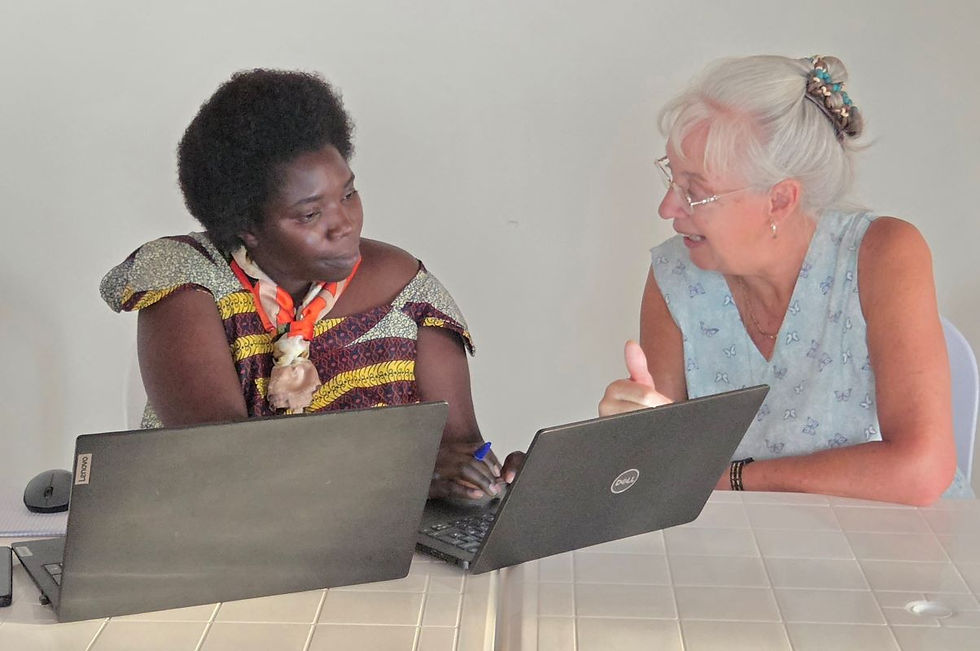
Having convinced the bishop we did not need to go out for dinner tonight and that coffee and fruit would be fine, he has gone to get his car washed, whilst we set to with blogs and reports.
As the sun sets on our last night in Karongi we will say a sad farewell to the small team who have looked after us so well. We will be back.


Good luck! Best wishes and prayers for the challenges ahead. John and Jean